






Healthcare workforce planning has transitioned from a tactical administrative task into a strategic imperative that determines quality of care, financial performance, staffing efficiency, and organizational resilience. Intensified by ongoing healthcare staffing shortages, burnout, and rapid shifts in patient demand, healthcare systems must equip themselves with advanced workforce planning frameworks, or risk persistent staffing gaps, rising labor costs, and compromised patient outcomes.
Today’s leaders are navigating complex healthcare staffing challenges while preparing for emerging healthcare staffing trends that will shape 2026 and beyond.
At IHCP, we help healthcare organizations transform their healthcare staffing strategy into a competitive advantage through data-driven healthcare workforce solutions, advanced labor forecasting in healthcare, predictive analytics, and flexible staffing optimization in healthcare environments. In this comprehensive guide, you’ll learn why workforce planning is mission-critical, how predictive tools reshape scheduling, and practical ways to build a future-ready workforce.
Why Healthcare Workforce Planning Is Mission-Critical Amid Healthcare Staffing Challenges
Modern healthcare leaders face unprecedented challenges:
Unprecedented Demand Growth Driving Hospital Staffing Pressure
- Healthcare worker shortages are intensifying globally and in the U.S., with an estimated shortfall of at least 10 million healthcare workers by 2030, impacting patient access and economic outcomes.
- The U.S. healthcare system alone is projected to be short about 3.2 million workers by 2026, driven by retirements, turnover, and expanding care needs—placing increased pressure on hospital staffing services and internal workforce planning teams.
Growing Clinician Attrition and Its Impact on Healthcare Staffing
- Over 138,000 nurses left the workforce since 2022, and up to 40% of nurses plan to exit the field by 2029, amplifying staffing instability.
- An aging workforce and high burnout are contributing to continued turnover, especially among physicians and nurses—forcing many organizations to rely on short-term medical staffing solutions and even emergency healthcare staffing during peak surges.
Healthcare Workforce Complexity Across Clinical and Operational Roles
- Shortages span multiple roles, from nurses and primary care physicians to allied health professionals, with an expected shortage of over 70,000 primary care physicians by 2037. These shortages complicate long-term healthcare staffing strategy development and increase operational risk.
Bottom line: traditional staffing tactics, like filling shifts with agency workers or reactive hiring, no longer work. To sustain quality care and operational stability, providers must adopt forward-looking workforce planning strategies.
Key Benefits of Strategic Healthcare Staffing Strategy and Workforce Solutions
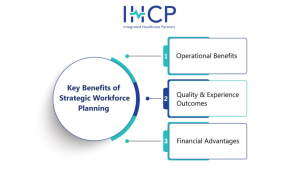
Workforce planning provides meaningful value far beyond simply weighing rosters—it forms the backbone of scalable healthcare workforce solutions:
Operational Benefits of Healthcare Staffing Optimization
- Reduced reliance on costly agency staff
- Lower overtime and staffing bottlenecks
- Improved schedule predictability
- Enhanced alignment between staffing levels and peak demand
Quality & Experience Outcomes from Strategic Workforce Planning
- Better clinician-to-patient ratios (linked to improved clinical outcomes)
- Reduced clinician burnout and turnover
- Stronger workforce morale and career development
- Improved patient satisfaction and access
Financial Advantages of Proactive Hospital Staffing Services
- Hospitals that implement advanced staffing optimization in healthcare environments experience stronger labor cost control.
- Proactive planning can lead to reduced overtime and recruitment costs over time
At IHCP, our approach combines healthcare workforce planning with elements of operational excellence consulting and healthcare recruitment consulting, ensuring workforce systems are aligned with long-term operational strategy—not just short-term coverage.
How Labor Forecasting in Healthcare Reduces Staffing Shortages and Gaps
What Is Labor Forecasting in Healthcare Workforce Planning?
Demand forecasting in healthcare staffing uses real data, including patient volumes, historical utilization patterns, outpatient metrics, and case acuity levels, to predict future clinical demand ahead of time.
This form of labor forecasting in healthcare strengthens overall healthcare workforce planning and reduces reactive hospital staffing decisions.
Why Demand Forecasting Matters in Modern Healthcare Staffing Strategy
- Demand forecasting helps healthcare leaders anticipate staffing shortages before they happen, not after.
- Forecast models help plan for peak seasons, weekend surges, and unexpected spikes like flu outbreaks.
IHCP’s Healthcare Workforce Solutions Forecasting Framework Includes:
- Historical patient census analysis
- Seasonal and cyclical modeling
- Case mix and acuity forecasting
- Staff capacity and availability mapping
- External trend integration
Practical Results from Predictive Workforce Planning
Healthcare systems that prioritize forecasting see:
- Lower overtime costs
- Fewer last-minute shifts
- More balanced workloads
- Enhanced workforce satisfaction
Example: In a regional hospital, integrating workforce forecasting reduced unplanned overtime by 22% while enhancing schedule reliability, a key driver of clinician retention.
Integrating Predictive Analytics into Hospital Staffing and Scheduling Systems
Predictive Analytics at Work in Hospital Staffing Environments
Predictive analytics uses machine learning and statistical models to identify future workforce needs and trends before they materialize. This capability is far beyond simple trend charts, it anticipates workforce stress points, likely shortages, and fluctuating demand cycles.
These workforce analytics healthcare capabilities are becoming foundational to modern healthcare staffing strategy.
Benefits of Predictive Workforce Analytics Healthcare Tools
- Enables staffing models that align with patient surges, seasonal variations, and clinical acuity shifts
- Allows early identification of:
- Overtime pressure points
- Staffing gaps in critical units
- Imminent turnover risks
- Float pool demands
Prediction + Scheduling = Precision in Healthcare Staffing
When predictive workforce insights are tied directly into scheduling systems:
- Managers can build smarter, adaptive schedules
- Staff allocations are based on anticipated demand
- Workforce efficiency improves while costs decline
IHCP assists clients with integration of predictive analytics into staffing workflows, ensuring that those insights translate into effective scheduling decisions.
Building a Multi-Skill, Flexible Healthcare Staffing Model for Surge Readiness
A flexible workforce is a future-ready workforce. Healthcare providers with rigid role definitions often struggle to adapt when demand swings.
Strategies for Flexibility in Emergency Healthcare Staffing Models
- Cross-training clinicians across units where appropriate
- Creating specialized float pools
- Skill-based staffing assignment models
- Flexible shift patterns with voluntary preference systems
Benefits of Multi-Skill Teams in Medical Staffing Solutions
- Reduces dependency on external agency staff
- Improves responsiveness during demand peaks
- Enhances morale by offering diverse clinical experiences
- Strengthens internal mobility pathways
At IHCP, we help organizations build skill matrices, assess cross-training potential, and align workforce capabilities with care delivery needs. This transforms staffing from a fixed cost into an adaptive resource.
Workforce Analytics Healthcare Tools That Drive Smarter Staffing Optimization
Workforce analytics healthcare tools provide the insights leaders need to manage complex staffing environments:
What Workforce Analytics Healthcare Dashboards Cover
- Staff availability and utilization metrics
- Turnover and retention predictors
- Cost per shift analysis
- Forecasted demand versus staffed capacity
- Department-level performance dashboards
- Predictive attrition and replacement modeling
Benefits of Data-Driven Healthcare Staffing Strategy
- Informed decision-making at the unit and enterprise level
- Reduced staffing inefficiencies
- Better workforce performance outcomes
Organizations that embrace workforce analytics can shift from reactive staffing to predictive and proactive planning, reducing labor waste and elevating care quality.
Healthcare Workforce Planning: Step-by-Step Staffing Optimization Framework
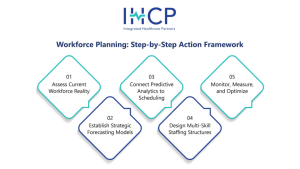
Here’s how healthcare organizations can move from reactive to proactive staffing planning:
1. Assess Current Healthcare Staffing and Workforce Planning Gaps
- Analyze existing staffing patterns and gaps
- Collect data on turnover, vacancy rates, and demand peaks
2. Establish Labor Forecasting in Healthcare Models
- Deploy demand forecasting tools using both historical and real-time data
- Integrate seasonal and episodic predictors (e.g., flu season)
3. Connect Predictive Analytics to Hospital Staffing Systems
- Use analytics to anticipate future states
- Embed insights directly into scheduling systems
4. Design Flexible Medical Staffing Solutions and Float Structures
- Identify cross-training opportunities
- Build flexible pools to support critical units
5. Monitor, Measure, and Optimize Staffing Optimization in Healthcare
- Continuously track performance indicators
- Adjust forecasting models and staffing strategies over time
At IHCP, we help healthcare providers execute this framework with precision and measurable outcomes.
Future Healthcare Staffing Trends Shaping Workforce Planning in 2026
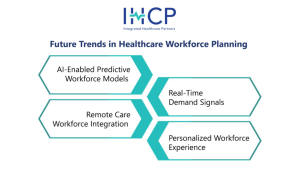
Healthcare workforce planning will continue to evolve with innovations that include:
AI-Enabled Predictive Workforce Models in Healthcare Staffing
- Leveraging artificial intelligence for deeper insights into staffing risks
Real-Time Demand Signals for Hospital Staffing Efficiency
- Using EHR and patient flow data to trigger staffing adjustments
Remote Care Workforce Integration in Healthcare Workforce Solutions
- Including telehealth and virtual care staffing into planning
Personalized Workforce Experience in Modern Healthcare Staffing Strategy
- Tailored schedules based on clinician preferences and wellbeing scores
These advancements will further close the gap between staffing capacity and real demand.
Conclusion: Solving Healthcare Staffing Challenges with Strategic Workforce Planning
Healthcare workforce planning is no longer an optional initiative, it is essential for organizations that want to deliver reliable, high-quality care in an era of complexity and rapid change. With projected shortages, rising clinician turnover, and increasingly unpredictable demand patterns, healthcare systems must embrace strategic workforce planning, labor forecasting, and workforce analytics to remain resilient.
At IHCP, we partner with healthcare leaders to develop and implement workforce planning strategies grounded in data, analytics, and operational best practices. Our approach transforms staffing challenges into strategic opportunities, improving care quality, reducing costs, and creating workforce stability.
Ready to future-proof your workforce?
Visit https://www.integratedhcp.com/ to learn how IHCP’s advanced healthcare workforce planning, staffing optimization, and predictive analytics solutions can support your organization’s goals for 2026 and beyond.
Frequently Asked Questions About Healthcare Workforce Planning and Staffing Solutions
What tools are used for workforce forecasting?
Workforce forecasting combines:
- Predictive analytics platforms
- Scheduling systems with forecast integration
- Workforce analytics dashboards
- Labor demand models using historical and real-time data
IHCP supports the selection and deployment of effective tools that integrate seamlessly with existing infrastructures.
How does predictive analytics improve workforce planning?
Predictive analytics helps healthcare organizations anticipate changes in staffing needs before they occur. It reveals trends such as rising overtime risks and looming shortages, enabling more strategic staffing decisions that improve efficiency, reduce cost, and enhance staff satisfaction.
How do hospitals balance float pools vs permanent hiring?
Balancing float pools and permanent staff starts with understanding variability in demand. Permanent hires provide continuity and deep institutional knowledge, while float pools offer flexibility during unpredictable surges. IHCP helps organizations use data to optimize this balance so that permanent hiring meets core needs and float pools handle variability efficiently.