







Healthcare organizations are facing an undeniable truth: retention is now the frontline workforce challenge. While staffing shortages continue to dominate headlines, the deeper issue lies in retaining skilled clinical talent in an increasingly demanding care environment. Burnout, limited growth pathways, and rapidly evolving clinical requirements are driving turnover at unsustainable levels.
Upskilling in healthcare has emerged as one of the most effective healthcare retention strategies available today. When executed strategically, healthcare staff training programs not only strengthen clinical capability but also improve engagement, morale, and long-term workforce stability.
At IHCP, clinical upskilling is positioned as a core pillar of healthcare talent management, aligning workforce development with organizational resilience, employee well-being, and care quality. Strengthening clinical skill development is no longer optional — it is central to modern healthcare workforce solutions.
Why Upskilling in Healthcare Has Become Essential for Workforce Retention
Healthcare turnover is no longer driven solely by compensation or workload. Increasingly, clinicians cite lack of professional growth and skill stagnation as primary reasons for leaving.
According to the 2024 NSI National Healthcare Retention Report:
- The average hospital turnover rate remains above 20%
- Replacement costs per bedside nurse range from $46,000 to $58,000
Meanwhile, a LinkedIn Workplace Learning Report found that:
- 94% of employees would stay longer at an organization that invests in their learning and development
Why Upskilling in Healthcare Impacts Staff Retention Directly
A structured clinical upskilling strategy supports staff retention by:
- Demonstrating organizational investment in staff growth
- Improving confidence and competence in evolving care environments
- Creating visible career progression pathways
- Reducing burnout through role mastery and flexibility
IHCP helps healthcare organizations shift from reactive training to structured, strategic upskilling in healthcare, designed to support both clinical excellence and long-term retention.
Identifying Clinical Skill Gaps to Strengthen Healthcare Workforce Solutions
Before launching any healthcare staff training initiative, organizations must clearly understand where skill gaps exist and how they impact care delivery, operational performance, and overall workforce stability healthcare objectives.
Common Causes of Clinical Skill Gaps in Healthcare Staffing
- Rapid adoption of new technologies and care models
- Increased patient acuity and complexity
- Regulatory and compliance changes
- Limited cross-training opportunities
- Workforce turnover disrupting skill continuity
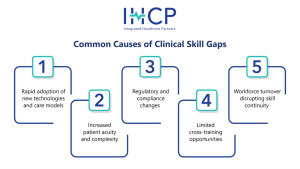
According to Deloitte, nearly 70% of healthcare leaders report skills gaps as a major barrier to operational performance and workforce optimization.
Tools for Conducting Skills Assessments in Healthcare Talent Management
Effective healthcare talent management relies on accurate skill visibility. Common tools include:
- Competency mapping frameworks
- Clinical skills inventories
- Workforce analytics platforms
- Performance and outcomes data
- Peer and supervisor assessments
IHCP supports organizations in combining quantitative workforce data with qualitative clinical insights to identify high-risk skill gaps and prioritize upskilling investments where they matter most.
Designing Role-Based Clinical Upskilling Strategy for Workforce Development
One-size-fits-all training programs rarely deliver meaningful impact. Successful upskilling in healthcare requires role-based, progression-driven pathways aligned to real clinical workflows and workforce planning objectives.
What a Role-Based Clinical Upskilling Strategy Looks Like
- Tailored learning tracks by role, specialty, and experience level
- Clearly defined skill milestones tied to clinical responsibilities
- Integration of both technical and soft-skill development
- Alignment with licensure, credentialing, and compliance standards
Benefits of Role-Based Training for Workforce Planning and Talent Development
- Faster skill adoption
- Higher engagement and completion rates
- Improved internal mobility
- Reduced dependency on external hiring
According to McKinsey, organizations that personalize workforce development are 30–50% more effective at building critical capabilities.
IHCP works with healthcare leaders to design scalable, role-based healthcare training programs that support both immediate clinical needs and long-term workforce development with long-term hospital staffing services resilience.
Integrating Microlearning and Simulation into Healthcare Staff Training Programs
Traditional classroom-based training models are often incompatible with modern clinical schedules. To drive engagement and skill retention, healthcare organizations are increasingly adopting microlearning and simulation-based training.
Why Microlearning Works in Healthcare Workforce Development
Microlearning delivers focused, bite-sized content that clinicians can apply immediately. Benefits include:
- Reduced time away from patient care
- Higher retention of critical skills
- Better alignment with shift-based schedules
A study published in the Journal of Medical Education found that microlearning improves knowledge retention by up to 25% compared to traditional methods.
The Role of Simulation Training in Clinical Skill Development
Simulation training enables clinicians to practice high-risk or complex scenarios in a safe environment, improving both confidence and outcomes.
Key benefits include:
- Improved clinical decision-making
- Reduced error rates
- Better interdisciplinary collaboration
IHCP helps organizations integrate microlearning, simulation labs, and digital training platforms into cohesive upskilling strategies that support continuous learning without overwhelming staff.
High-Demand Clinical Skills Shaping Healthcare Staffing Trends in 2026
As care models evolve, certain clinical skills are becoming increasingly critical across healthcare systems.
High-Demand Clinical Skills Include Key Capabilities for Workforce Stability
- Advanced patient assessment and acuity management
- Digital health and EHR optimization
- Telehealth and remote patient monitoring
- Care coordination and interdisciplinary collaboration
- Data-driven clinical decision-making
- Leadership and charge nurse competencies
According to the World Economic Forum, healthcare roles are among those experiencing the fastest skill evolution, requiring continuous upskilling to remain effective.
IHCP aligns upskilling initiatives with these emerging skill demands, ensuring organizations remain clinically agile and future-ready.
Measuring the Impact of Healthcare Staff Training on Turnover and Employee Engagement
Upskilling initiatives must deliver measurable results. Without clear metrics, even well-designed healthcare staff training programs risk losing executive support.
Key Metrics to Track Healthcare Turnover and Employee Engagement
- Turnover rates pre- and post-training
- Internal promotion and mobility rates
- Engagement and satisfaction scores
- Clinical performance and outcome indicators
- Time-to-competency for new skills
According to Gallup, organizations with high employee engagement experience 59% lower turnover.
IHCP helps healthcare organizations connect training outcomes directly to retention metrics, enabling leaders to quantify the ROI of clinical skill development initiatives.
Case Study: Workforce Development Healthcare Program That Increased Staff Retention
The Challenge: Rising Healthcare Staffing Challenges and Turnover
A multi-facility healthcare system was experiencing:
- Annual clinical turnover exceeding 24%
- Rising recruitment and onboarding costs
- Low engagement scores among mid-career clinicians
IHCP’s Upskilling Approach to Strengthening Healthcare Workforce Solutions
IHCP partnered with leadership to:
- Conduct a comprehensive skills assessment
- Identify critical skill gaps across nursing and allied health roles
- Design role-based upskilling pathways
- Implement microlearning and simulation training
- Track retention and engagement metrics over 12 months
Results: Improved Staff Retention and Reduced Reliance on Medical Staffing Solutions
- 20% improvement in retention rates
- Higher internal mobility and promotion rates
- Improved staff engagement and confidence
- Reduced reliance on external hiring
This case demonstrates how strategic upskilling in healthcare can transform workforce stability while enhancing clinical capability.
Conclusion: Turning Upskilling in Healthcare Into a Competitive Advantage
Clinical upskilling is no longer a discretionary investment — it is a competitive necessity. Healthcare organizations that prioritize clinical skill development, staff engagement, and employee well-being healthcare initiatives are better positioned to retain talent, deliver quality care, and adapt to ongoing change.
By aligning healthcare talent management strategies with structured upskilling pathways, organizations can reduce turnover, strengthen culture, and build resilient clinical teams.
IHCP partners with healthcare organizations to design and implement upskilling strategies that drive measurable retention gains, workforce engagement, and long-term success.
Frequently Asked Questions About Upskilling in Healthcare and Retention Strategies
Which clinical skills are in highest demand today?
High-demand skills include advanced patient assessment, digital health proficiency, telehealth delivery, care coordination, and leadership capabilities. These skills are essential for adapting to evolving care models and patient needs.
How do hospitals measure upskilling ROI?
Hospitals measure ROI through turnover reduction, engagement scores, internal mobility rates, improved clinical outcomes, and reduced recruitment costs. Linking training data to workforce analytics is key.
What training formats improve skill adoption fastest?
Microlearning, simulation-based training, and role-based learning pathways deliver faster skill adoption due to their flexibility, relevance, and real-world application.
If your organization is exploring clinical skill development, healthcare staff training, healthcare retention strategies, or upskilling in healthcare, IHCP can help.
Visit https://www.integratedhcp.com/ to learn how IHCP’s workforce development and retention strategies support sustainable clinical excellence and long-term workforce stability.