







As healthcare systems expand across state lines, multi-state licensure healthcare compliance has become one of the most complex and high-risk operational challenges leaders face today. Between evolving state regulations, clinician mobility, staffing shortages, and increased regulatory scrutiny, managing licensure compliance at scale requires far more than manual tracking and periodic audits.
Failure to maintain licensure compliance can lead to delayed onboarding, denied reimbursements, regulatory penalties, reputational damage, and even suspension of clinical services. For large healthcare systems, these risks multiply with every additional state of operation and directly impact healthcare workforce stability.
At IHCP, multi-state licensure compliance is treated as a strategic workforce and risk management function, one that must be tightly integrated with credentialing, staffing audits, and operational planning to support sustainable growth. As a healthcare consulting firm specializing in workforce risk mitigation, IHCP aligns compliance strategy with broader healthcare workforce solutions.
Why Multi-State Licensure Healthcare Compliance Is Becoming More Complex
Healthcare organizations are expanding geographically faster than regulatory frameworks are simplifying. Several forces are driving increased complexity across healthcare staffing operations:
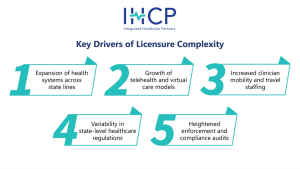
Key Drivers of Licensure Complexity in Healthcare Staffing and Regulatory Compliance
- Expansion of health systems across state lines
- Growth of telehealth and virtual care models
- Increased clinician mobility and travel staffing
- Variability in state-level healthcare regulations
- Heightened enforcement and compliance audits
According to the Federation of State Medical Boards (FSMB), physicians practicing across multiple states face distinct licensure, renewal, and documentation requirements in each jurisdiction, even when clinical roles are identical.
Meanwhile, the U.S. Department of Health and Human Services (HHS) reports that regulatory non-compliance remains a leading contributor to operational delays and revenue leakage in healthcare systems.
For large healthcare systems, managing this complexity manually increases risk exposure and slows workforce deployment, especially during periods of high demand.
Key Differences Between State Licensing Requirements in Healthcare Compliance
Despite national standards in education and training, healthcare licensure is governed at the state level. This creates significant variability that organizations must actively manage to maintain regulatory compliance.
Common Areas Where State Requirements Differ in Credentialing Compliance
- Initial licensure application processes
- Renewal timelines and grace periods
- Continuing education (CE) requirements
- Scope-of-practice definitions
- Background checks and fingerprinting
- Reporting obligations for disciplinary actions
Even a single missed renewal deadline can result in a clinician being temporarily or permanently barred from practicing in that state, causing scheduling disruptions and compliance exposure.
IHCP helps healthcare organizations identify and map these differences across jurisdictions, ensuring licensure compliance frameworks are built on accurate, up-to-date regulatory intelligence.
Compact vs Non-Compact States in Multi-State Licensure Healthcare
One of the most misunderstood aspects of multi-state licensure healthcare compliance is the difference between compact and non-compact states.
What Are Licensure Compacts in Multi-State Healthcare Compliance?
Licensure compacts allow clinicians to practice in multiple states under a single license, provided those states participate in the compact.
Common compacts include:
- Nurse Licensure Compact (NLC)
- Interstate Medical Licensure Compact (IMLC)
- Physical Therapy Compact (PT Compact)
According to the National Council of State Boards of Nursing (NCSBN), over 40 U.S. jurisdictions participate in the Nurse Licensure Compact, enabling faster clinician mobility across healthcare workforce networks.
Why Compacts Don’t Eliminate Compliance Risk for Healthcare Staffing Agencies
- Not all states participate
- Compact eligibility criteria vary
- Clinicians must maintain a primary state of residence
- Disciplinary actions can still impact multi-state privileges
IHCP helps healthcare organizations navigate compact eligibility, exceptions, and documentation requirements to avoid false assumptions that lead to compliance gaps that can impact medical staffing solutions and operational continuity.
How to Track Licenses Across Multiple Jurisdictions with Clinician License Tracking Systems
Tracking clinician licenses across multiple states is one of the most operationally intensive aspects of credentialing compliance. Without centralized systems, organizations risk fragmented data, expired licenses, and audit failures.
Core Challenges in Clinician License Tracking Across Healthcare Systems
- Multiple renewal dates and cycles
- Inconsistent documentation formats
- Manual reminders and follow-ups
- Limited visibility across departments
- Delayed onboarding due to verification bottlenecks
According to CAQH, manual credentialing and license verification processes can take up to 60–90 days, significantly slowing workforce deployment.
Best Practices for License Tracking in Hospital Staffing Services
- Centralized clinician license tracking systems
- Real-time status visibility across jurisdictions
- Automated alerts for renewals and expirations
- Integration with credentialing and staffing audits
- Clear ownership and escalation workflows
IHCP works with healthcare organizations to design scalable clinician license tracking frameworks that reduce administrative burden while strengthening compliance oversight.
Credentialing Documentation Checklist for Credentialing Compliance & Staffing Audits
Accurate documentation is the foundation of licensure compliance and successful staffing audits.
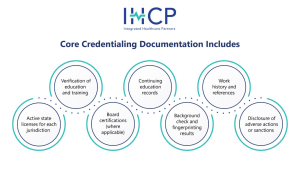
Core Credentialing Documentation Includes for Staffing Audits and Healthcare Audits:
- Active state licenses for each jurisdiction
- Verification of education and training
- Board certifications (where applicable)
- Continuing education records
- Background check and fingerprinting results
- Work history and references
- Disclosure of adverse actions or sanctions
Missing or outdated documentation is one of the most common findings in credentialing audits.
According to the Office of Inspector General (OIG), incomplete credentialing documentation remains a leading compliance risk identified during healthcare systems.
IHCP supports healthcare organizations in standardizing credentialing documentation processes to ensure audit readiness across all operating states.
Avoiding Common Multi-State Licensure Healthcare Compliance Pitfalls
Even well-resourced healthcare systems and hospital staffing services encounter recurring licensure compliance issues.
Common Multi-State Licensure Pitfalls in Healthcare Workforce Operations
- Assuming compact participation covers all states
- Failing to track state-specific CE requirements
- Relying on clinicians to self-manage renewals
- Lack of real-time license status visibility
- Inconsistent onboarding workflows across states
These issues often surface during staffing audits, payer reviews, or regulatory inspections, when remediation timelines are limited.
IHCP helps organizations proactively identify and mitigate these risks through structured multi-state licensure healthcare frameworks embedded into broader healthcare workforce solutions.
Tools for Automated License Monitoring in Healthcare Workforce Solutions
As workforce scale increases, automation becomes essential to maintaining compliance and reducing risk across healthcare staffing operations.
What Automated License Monitoring Tools Do for Healthcare Compliance
- Continuously monitor license status across states
- Send automated renewal alerts
- Flag compliance risks in real time
- Integrate with credentialing and staffing systems
- Support audit reporting and documentation
According to Deloitte, organizations that automate compliance monitoring reduce regulatory risk incidents by up to 40%.
Benefits of Automation for Healthcare Workforce Solutions and Medical Staffing Solutions
- Reduced administrative workload
- Improved audit readiness
- Faster clinician onboarding
- Lower compliance risk exposure
IHCP helps healthcare organizations evaluate, implement, and integrate automated license monitoring tools into broader healthcare compliance, risk management, and medical staffing solutions strategies.
Conclusion: Strengthening Healthcare Compliance Through Strategic Workforce Solutions
As healthcare organizations expand across state lines, multi-state licensure healthcare compliance has become a critical operational and risk management priority. The complexity of state regulations, combined with workforce mobility and heightened scrutiny, demands proactive, system-wide compliance strategies.
By investing in centralized clinician license tracking, automated monitoring tools, and standardized credentialing audits, healthcare systems can reduce risk, accelerate onboarding, and strengthen healthcare workforce resilience.
IHCP partners with healthcare organizations to master licensure compliance across jurisdictions, ensuring staffing operations remain compliant, efficient, and audit-ready.
If your organization operates across multiple states and is navigating licensure compliance, credentialing audits, clinician license tracking, or healthcare staffing regulations, IHCP can help.
Visit https://www.integratedhcp.com/ to learn how Integrated HCP supports healthcare organizations with scalable compliance, risk management, and multi-state workforce solutions.
Frequently Asked Questions About Multi-State Licensure Healthcare Compliance
What is multi-state licensure healthcare compliance?
It refers to the process of managing clinician licenses, renewals, and regulatory requirements across multiple state jurisdictions while ensuring ongoing compliance with state-specific regulations.
How do healthcare organizations prepare for credentialing audits?
Preparation includes maintaining accurate documentation, centralized license tracking, automated renewal monitoring, and standardized compliance workflows across all operating states.
Why is clinician license tracking critical?
Without accurate clinician license tracking, organizations risk expired licenses, compliance violations, delayed onboarding, and regulatory penalties.