







The U.S. healthcare system is entering 2025 facing its most significant workforce challenge in decades. According to the American Hospital Association, nearly 6 in 10 hospitals report critical staffing shortages, with rural and community hospitals being hit the hardest. In fact, Becker’s Hospital Review recently highlighted that the U.S. may face a shortage of 124,000 physicians by 2034, and the American Nurses Association has projected that more than 500,000 experienced RNs will retire by 2026 —further increasing the need for medical staffing solutions and reliable healthcare staffing agencies.
Despite billions in funding for technology adoption, telemedicine, and workforce development, the demand for skilled clinicians continues to outpace supply. Shortages have now become a persistent, systemic issue, not just a temporary side effect of the pandemic—making healthcare workforce solutions and hospital staffing services more crucial than ever.
In this guide, we’ll explore why shortages persist, how healthcare staffing agencies provide fast and compliant solutions, and what flexible healthcare staffing models look like in 2025.
The Current State of the Healthcare Workforce Shortage in 2025
The healthcare workforce crisis isn’t new, but its intensity in 2025 is striking. Three factors are driving the shortage:
- Aging Population: By 2030, all baby boomers will be over 65, increasing demand for chronic disease management, surgeries, and long-term care.
- Early Retirements: Many clinicians accelerated retirement plans after the pandemic, leaving gaps in highly skilled roles.
- Pipeline Constraints: Nursing schools turned away 80,000 qualified applicants in 2024 due to limited faculty and training resources.
Case Study: Flu Season Surge
A 250-bed hospital in the Midwest faced a sudden flu outbreak in January 2025. Emergency room admissions increased by 40% within 14 days, pushing patient-to-nurse ratios above safe thresholds.
- Day 1: Hospital leadership recognized their ICU and ER were at risk of being understaffed.
- Day 2: They contacted a healthcare staffing agency with a request for 20 temporary clinicians.
- Day 3: The agency mobilized 15 nurses and 5 respiratory therapists from its rapid-response pool—leveraging rapid response healthcare staffing and digital credentialing.
- Day 5: The clinicians were integrated into shifts, easing workloads and preventing the hospital from going on diversion.
Result: The hospital avoided turning patients away, preserved staff morale, and protected quality-of-care scores.
This case demonstrates how staffing agencies are no longer just a backup option—they are a strategic partner in crisis management.
Why Staffing Shortages Persist Despite Technology & Funding
Hospitals have invested heavily in EHR systems, predictive scheduling, and AI-driven workflow automation. States have funded workforce development programs and offered scholarships. Yet, gaps remain.
- Burnout & Attrition: A 2025 survey by AMN Healthcare found that 85% of nurses report feeling burned out, and 38% are considering leaving the profession within two years.
- Training Bottlenecks: While applications to nursing schools rise each year, faculty shortages mean thousands of qualified students are denied admission.
- Geographic Gaps: Incentives like sign-on bonuses and loan forgiveness often fail to attract providers to rural communities, where shortages are most acute.
Technology eases documentation, scheduling, and telehealth—but it cannot replace hands-on clinical care, reinforcing the need for medical staffing solutions and specialized healthcare workforce solutions.
How Healthcare Staffing Agencies Source Skilled Clinicians Quickly
Healthcare staffing agencies have evolved into speed-focused, compliance-driven organizations that bridge the talent gap.
Methods They Use:
- National Talent Pools: Agencies maintain rosters of travel nurses, per-diem clinicians, and specialists who are pre-vetted and available.
- AI Matching: Algorithms cross-check availability, specialty, and compliance documentation to place clinicians in hours—not weeks.
- Rapid Credentialing: Digital platforms verify licensure, immunization records, and background checks instantly.
- Predictive Staffing: Agencies now use demand-forecasting models to anticipate flu season surges, natural disasters, or elective surgery spikes.
Human-first impact: Hospitals get clinicians who are ready to work from Day 1, while clinicians gain flexibility to choose assignments that fit their lifestyle.
Compliance Checklist for Rapid Healthcare Hiring
Speed is critical—but compliance cannot be compromised. Healthcare staffing agencies must ensure every professional is cleared to work safely and legally.
Here’s a rapid onboarding checklist used in U.S. facilities:
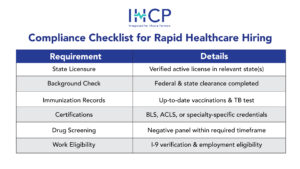
Lessons Learned: Why This Matters
When hospitals skip steps due to urgency, they risk liability, fines, and patient safety. For example, during the 2023 nursing shortage in Texas, several hospitals faced compliance audits that revealed incomplete credentialing. Partnering with the best healthcare staffing agency helps facilities avoid such risks while still moving quickly.
The Future of Flexible Healthcare Staffing
In 2025, flexible healthcare staffing models have become the standard. Staffing agencies are shaping the future by offering diverse models that cater to both hospital needs and clinician preferences.
- Short-Term Contracts: 4–12 week contracts to cover seasonal surges.
- Per-Diem Roles: Same-day or next-day shift coverage for unexpected absences.
- Travel Assignments: Long-term placements (13–26 weeks) in high-need areas.
- Telehealth Integration: Hybrid models where specialists support remotely, while bedside staff handle in-person care.
- Work-Life Balance: Clinicians increasingly choose staffing agencies to control their schedules and avoid burnout.
This level of flexibility, backed by healthcare recruitment consulting expertise, helps hospitals manage fluctuations and remain fully staffed.
Conclusion
Healthcare staffing shortages won’t disappear overnight. Burnout, demographic shifts, and training bottlenecks mean the U.S. healthcare system must continue adapting. Healthcare staffing agencies are proving indispensable by offering compliant, fast, and flexible solutions that keep hospitals running and patients cared for.
As seen in the flu season case study, these agencies are not just stopgaps—they are strategic partners enabling hospitals to handle surges, maintain safety, and protect revenue.
If your organization is struggling to balance patient care with workforce challenges, now is the time to explore flexible staffing strategies.
IHCP supports hospitals nationwide with healthcare workforce solutions, medical staffing, and tailored workforce planning that ensure continuity of care.
Q&A
Q: How do healthcare staffing agencies address clinician shortages?
A: Staffing agencies maintain national databases of qualified clinicians, use AI-powered matching to fill shifts quickly, and provide flexible options like travel nurses, per-diem shifts, and short-term contracts. They bridge gaps that hospitals cannot fill through traditional hiring alone.
Q: What compliance issues arise during rapid healthcare hiring?
A: Common risks include incomplete background checks, lapsed certifications, missing immunizations, and state licensure mismatches. A staffing agency minimizes these risks by maintaining strict credentialing protocols and automating verification.
Q: What does flexible staffing look like in 2025?
A: Flexible staffing now goes beyond travel nurses. It includes hybrid telehealth + onsite support, contract-to-hire roles, and per-diem scheduling apps. For hospitals, this means agility during labor shortages. For clinicians, it means more control over work-life balance.
Q: Why not just hire permanent staff instead of using staffing agencies?
A: Permanent hiring is ideal, but it takes months—often six or more—to fill roles. Agencies provide an immediate solution during seasonal surges, unexpected resignations, or specialty shortages.